How to Remove Limescale and Hard Water Stains from Tapware Naturally
Limescale on tapware and showerheads is calcium and magnesium carbonate deposited when hard water evaporates from a surface. It responds well to mild acids: white vinegar for regular maintenance, citric acid for established deposits. The Gold Coast has notably hard tap water, which means limescale accumulates faster here than in most Australian cities. The treatment is straightforward and requires nothing beyond products already in most kitchens.
Green Wave Cleaning Team
Gold Coast & Brisbane
Limescale on tapware and showerheads is calcium and magnesium carbonate deposited when hard water evaporates on a metal or glass surface. It looks like a white or chalky crust around the base of taps, on the face of showerheads, and along the bottom edge of bathroom and kitchen fixtures. In advanced cases it dulls chrome finishes and blocks the holes in showerheads.
Gold Coast tap water has measurable calcium and magnesium content from the groundwater and reservoir sources it uses. This means limescale accumulates on tapware and shower screens faster in a Gold Coast home than in Sydney or Melbourne, and significantly faster than in areas with naturally soft water. Understanding why it accumulates quickly is the starting point for knowing how to treat it effectively.
Contents
- What limescale actually is
- Why Gold Coast and Brisbane water produces more limescale
- Natural treatments that work
- How to treat tapware step by step
- How to treat a showerhead
- Shower screens and glass surfaces
- Kitchen tapware and the sink area
- What not to use
- How to slow the rate of build-up
- When we are not the right fit
- Frequently Asked Questions
What limescale actually is
Tap water contains dissolved minerals, primarily calcium carbonate and magnesium carbonate, in concentrations that vary by location and water source. When water evaporates from a surface, the dissolved minerals do not evaporate with it. They remain, forming a thin deposit that accumulates over successive evaporation events into the visible white crust known as limescale.
The rate of accumulation depends on two factors: the mineral content of the water (hardness) and the frequency of wetting and drying on the surface. A kitchen sink tap that is used many times per day and left to air dry accumulates limescale faster than a shower tap that runs for longer but is less frequently left with standing droplets.
Limescale is chemically a carbonate mineral, which means it responds to acid treatment. A mild acid dissolves the carbonate and allows it to be rinsed away. This is the mechanism behind the effective natural treatments.
Why Gold Coast and Brisbane water produces more limescale
Water hardness is measured in milligrams per litre of calcium carbonate (mg/L CaCO3). Seqwater, the bulk water provider for southeast Queensland, publishes water quality data showing that Gold Coast and Brisbane tap water typically measures in the moderate to moderately hard range, between 60 and 120 mg/L. This is higher than the naturally soft water in some eastern Australian cities and produces visible limescale accumulation within weeks on untreated tapware.
The Gold Coast specifically draws part of its water supply from groundwater sources that have higher mineral content than surface water. Combined with the warm climate, which accelerates evaporation, the practical result is limescale forming noticeably faster on Gold Coast tapware than in cooler or softer-water cities.
In practical terms: a bathroom tap in a Gold Coast home that is wiped clean but not specifically descaled will show visible chalky deposits within two to four weeks under normal use.
Natural treatments that work
White vinegar is the starting point for limescale treatment. It is a dilute acetic acid solution, typically three to eight percent acid concentration, which is effective against fresh and light limescale deposits. It is safe on chrome, stainless steel, ceramic, and glass when used as directed. It is not appropriate on natural stone, powder-coated surfaces, or gold or copper-toned tapware finishes.
Citric acid powder is a stronger acid treatment and more effective on established, hardened limescale that has built up over months. Available from most supermarkets and health food stores. Used as a solution of one to two tablespoons in 500ml of warm water for general treatment, or more concentrated for severe deposits. More effective than vinegar for significant build-up, with a lower odour.
Lemon juice contains citric acid naturally and works on light deposits in the same way as a diluted citric acid solution. Less consistent in concentration than powder citric acid. Useful when you want a quick treatment with something already in the kitchen.
How to treat tapware step by step
For light to moderate deposits (white chalky surface layer):
- Soak a cloth or paper towel in undiluted white vinegar.
- Wrap the cloth around the affected tapware, covering the deposit area fully.
- Leave for thirty minutes. For light deposits, fifteen minutes is often sufficient.
- Remove the cloth and use an old toothbrush or soft brush to scrub the loosened deposit from the surface.
- Rinse with water and dry with a clean cloth.
- Buff chrome surfaces with a dry microfibre cloth to restore the shine.
For established deposits that have built up over months:
- Mix a citric acid solution: one to two tablespoons of citric acid powder in 500ml of warm water.
- Soak a cloth in the solution and wrap it around the tapware.
- Leave for one to two hours, or longer for severe deposits.
- Scrub with a toothbrush while wet. The deposit should crumble or scrape away with the brush.
- Rinse thoroughly and dry.
- For deposit that remains after the first treatment, repeat. Hardened limescale from six months or more of accumulation may need two or three treatments.
Around the tap base (the area at the join between the tap body and the surface):
This area accumulates both limescale and soap residue in a gap that is hard to reach with a cloth. Apply citric acid solution with a toothbrush directly into the gap, allow to sit, and scrub with the toothbrush. An old toothbrush is the most effective tool for this specific area.
How to treat a showerhead
Showerheads accumulate limescale inside the spray holes as well as on the exterior. As the internal limescale builds, individual spray holes become partially or fully blocked, changing the spray pattern and reducing flow.
For a removable showerhead:
- Remove the showerhead from the arm.
- Submerge it in a container of white vinegar or citric acid solution: one tablespoon of citric acid per cup of water.
- Leave to soak for one to two hours.
- Use a toothpick or thin brush to clear any blocked spray holes.
- Rinse thoroughly and reattach.
For a fixed showerhead that cannot be removed:
- Fill a plastic bag with white vinegar or citric acid solution.
- Position the bag so the showerhead face is submerged in the liquid.
- Secure the bag in place with a rubber band around the showerhead arm.
- Leave for one to two hours.
- Remove the bag and run the shower on full to flush the loosened deposits from the spray holes.
- Wipe the exterior with a cloth.
The soak time is important. Limescale inside the holes needs time in contact with the acid to dissolve. A quick spray and wipe does not address internal blockages.
Shower screens and glass surfaces
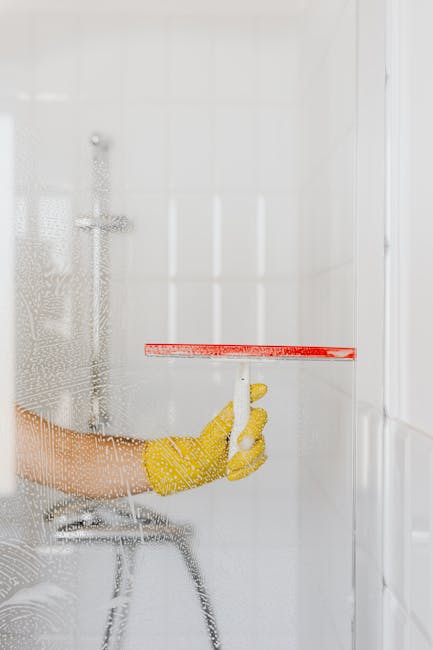
Glass shower screens in Gold Coast and Brisbane homes develop visible mineral spotting within weeks of installation if not maintained. The spots are the same calcium and magnesium carbonate deposits as on tapware, and they respond to the same acid treatment.
For light spotting: White vinegar sprayed directly on the glass, left for fifteen minutes, then scrubbed with a non-scratch pad and rinsed. Dry immediately with a squeegee.
For established deposits: Citric acid solution applied to the glass surface, left for twenty to thirty minutes, scrubbed with a non-scratch pad in circular motions, and rinsed. For very heavy mineral deposits that have built up over a year or more, a commercial eco glass descaler may be needed as a first pass, followed by the citric acid treatment.
Do not use steel wool or abrasive scourers on glass. These scratch the glass surface permanently and the micro-scratches trap mineral deposits faster than smooth glass.
Kitchen tapware and the sink area
Kitchen taps accumulate limescale in two patterns: the area immediately around the tap base where water sits after use, and the underside of the spout where drips dry repeatedly.
The sink area, particularly around drain fittings and the area where the tap meets the bench or sink surface, develops a hard mineral crust that is a combination of limescale and soap residue. This is best treated with a citric acid solution applied directly and left for twenty to thirty minutes before scrubbing.
For kitchen taps with a pull-out spray function, the hose connection area and the spring of the hose also accumulate deposits and benefit from the same vinegar or citric acid treatment.
What not to use
Bleach: Not effective on limescale. Bleach is a disinfectant and oxidising agent, not an acid. It does not dissolve calcium carbonate deposits. Using bleach on limescale does nothing except add a chemical to the surface.
Abrasive scrubbing pads on chrome: Abrasive cleaning on chrome tapware scratches the plating, creating micro-abrasions that dull the finish permanently and trap more limescale in future.
Strong commercial acid cleaners on natural stone or unverified surfaces: Products marketed for heavy limescale removal often contain strong mineral acids such as hydrochloric acid. These will damage natural stone tile surfaces, etch chrome if left too long, and react with powder-coated or gold-plated finishes. For household tapware and glass, the eco treatments above are both effective and safe.
Vinegar or citric acid on natural stone: Marble, travertine, limestone, and granite are calcium carbonate minerals. Acidic cleaners dissolve them just as they dissolve limescale. The result is etching: a dull, irregular surface that cannot be easily restored. Do not use vinegar or citric acid on natural stone surfaces.
How to slow the rate of build-up
Dry surfaces after use. The most effective prevention is removing the water before it evaporates. A quick wipe of tapware after use with a dry cloth, or squeegeeing the shower screen after each shower, removes the water that leaves mineral deposits when it dries. This habit makes the most significant difference to the rate of accumulation.
Regular maintenance treatment. A monthly vinegar wipe of all bathroom tapware takes ten minutes and prevents the build-up from progressing to the hardened, multi-layer deposits that require extended treatment.
Ventilation. Good bathroom ventilation reduces the humidity that keeps tapware wet after use and slows the evaporation cycle that deposits minerals.
When we are not the right fit
Limescale treatment on household tapware is a task most homeowners can handle with the steps above. It does not require a professional cleaning service for the treatment itself.
What we do is maintain the bathroom as part of a regular cleaning schedule, including tapware descaling as part of the periodic deep clean scope. For households that want tapware and shower surfaces maintained at a high standard without having to manage it themselves, it is one of the items specifically covered in a deep cleaning service.
For ongoing domestic cleaning across the Gold Coast and Brisbane that includes bathroom maintenance, get a quote at greenwavecleaning.com.au/get-a-quote.
Frequently Asked Questions
What causes limescale on tapware?
Limescale is calcium and magnesium carbonate deposited when hard water evaporates on a surface. Gold Coast and Brisbane tap water has moderate to moderately hard mineral content that produces visible limescale on tapware within weeks if the surfaces are left to air dry. The mineral deposits accumulate over successive evaporation events into the white chalky crust seen around tap bases, on showerheads, and on shower screen glass.
How do I remove limescale from tapware without harsh chemicals?
Soak a cloth in white vinegar and wrap it around the affected tapware. Leave for thirty minutes to an hour, then scrub with a toothbrush and rinse. For established deposits from several months of accumulation, a citric acid solution (one tablespoon per 500ml of warm water) with a longer soak of one to two hours is more effective. Both approaches are safe on chrome and stainless steel and do not require harsh chemical products.
Can I use vinegar on my shower screen for water spots?
Yes. Spray undiluted white vinegar on the glass surface, leave for fifteen minutes, scrub with a non-scratch pad, and rinse. Dry immediately with a squeegee or clean cloth. For heavy mineral spotting that has built up over months, a citric acid solution with a longer dwell time produces a better result. Do not use abrasive scourers on glass.
How often should I descale tapware in a Gold Coast home?
A monthly wipe with white vinegar prevents accumulation from becoming established and takes under ten minutes per bathroom. If descaling is done only as part of a periodic deep clean, every three to four months is a practical minimum. Gold Coast water hardness means that tapware left for six months or more without descaling treatment will have developed hardened deposits that require extended treatment to remove.
Is citric acid or vinegar better for limescale?
Citric acid is more effective than vinegar for established, hardened limescale deposits. Vinegar is appropriate for regular maintenance and light to moderate deposits. Both are mild, eco-friendly acids that dissolve calcium carbonate without harsh chemical products. Citric acid powder mixed into a solution gives you more control over the concentration than vinegar, which has a fixed acidity. For most household tapware maintenance, vinegar is sufficient. For a showerhead or tapware that has not been descaled in over a year, start with citric acid.
Photo: Pexels — royalty free
Need professional eco cleaning?
Green Wave Cleaning serves Gold Coast and Brisbane with plant-based, eco-certified products on every job.
Get a personalised quote